AI News & Strategic Updates
Curated weekly analysis of AI breakthroughs, strategic moves, and emerging trends shaping governance and compliance. Each briefing distills critical developments that impact enterprise AI strategy.
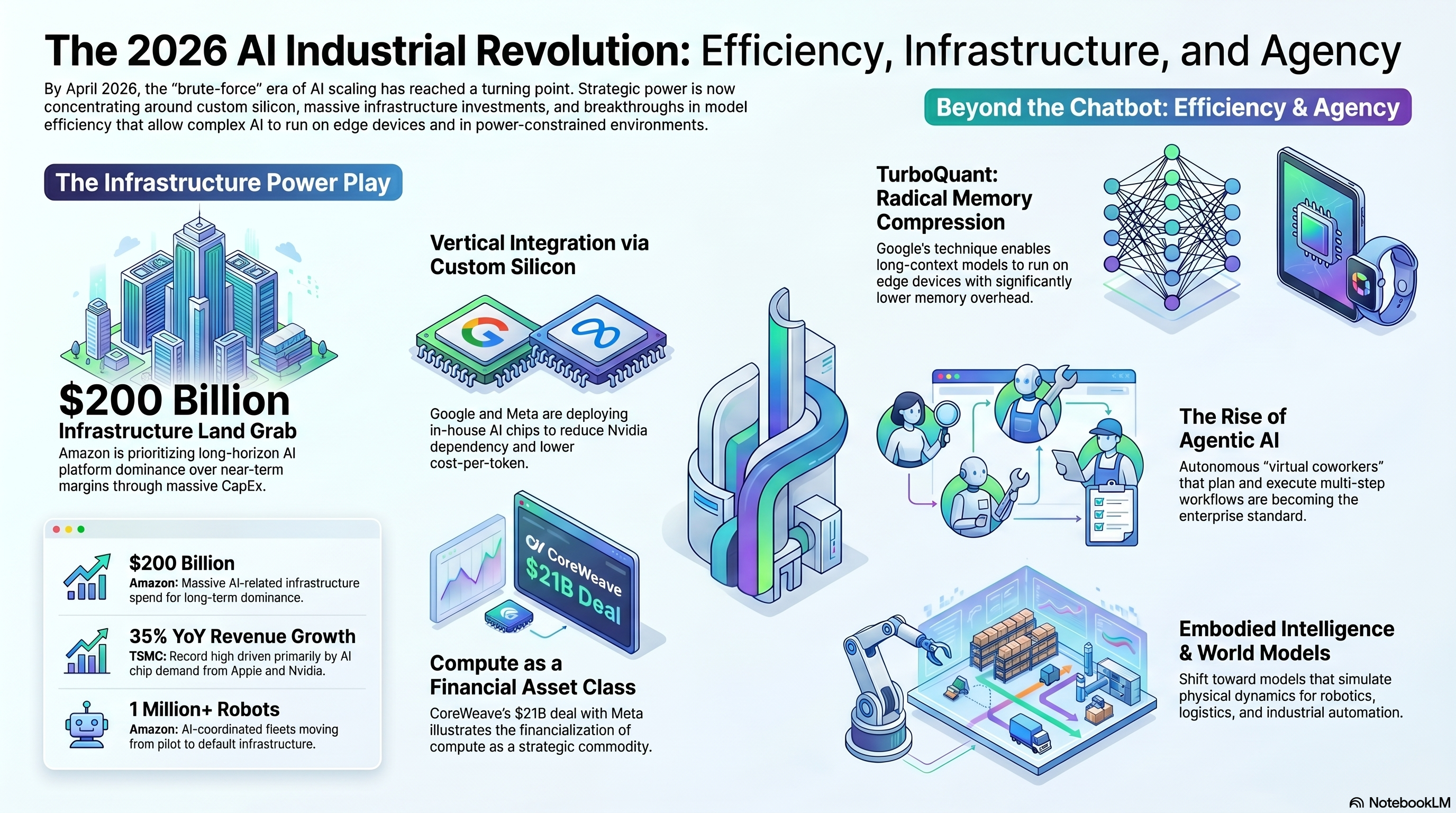
The 2026 AI Industrial Revolution: Efficiency, Infrastructure, and Agency
By April 2026, the “brute-force” era of AI scaling has reached a turning point. Strategic power is now concentrating around custom silicon, massive infrastructure investments, and breakthroughs in model efficiency that allow complex AI to run on edge devices and in power-constrained environments.
Watch: The New AI Stack
Video overview of April’s key developments across efficiency, infrastructure, and agency
Scroll down for each week’s individual briefing with full analysis and sources.
AI Industrializes: Chips, Efficiency, and Governance-Ready Agents
This week’s tech story: AI continues to industrialize across chips, efficiency, and agents. Hyperscalers double down on infrastructure and partnerships, while “AI infra everywhere” becomes the dominant emerging trend.
AI and ML Breakthroughs
Google’s TurboQuant work, highlighted around ICLR 2026, targets one of the most painful scaling bottlenecks: the KV cache for long-context transformers. Using a two-step approach (vector rotation plus structured compression), it shrinks memory overhead while preserving accuracy on long-sequence tasks—directly lowering inference cost and enabling larger effective context windows on existing hardware.
Siemens introduced an AI system for automation engineering, aimed at generating, validating, and maintaining industrial automation code. This is a concrete move from “AI assistant for developers” to “AI co-engineer for physical automation systems,” with implications for manufacturing productivity and safety-critical workflows.
OpenAI updated its Agents SDK with improved governance and control features, emphasizing safe orchestration of multi-step, tool-using agents in production contexts—aligning with the broader pivot from single-turn chatbots to persistent, workflow-embedded agents.
Big Tech Moves
At Cloud Next 2026, Google announced two new AI chips framed as alternatives to Nvidia GPUs, with supply agreements already signed with OpenAI, Anthropic, and reportedly Meta—signaling a strategy to become a “neutral AI foundry” while deepening customer dependency on its vertically integrated stack.
U.S. chip stocks hit record highs as Intel posted stronger-than-expected revenue driven by AI demand. Nvidia faces the paradox of supplying critical hardware to cloud providers simultaneously building in-house alternatives, increasing strategic risk of being “indispensable but undercut.”
SpaceX is reported to have an option to acquire AI coding tool Cursor for ~$60B, while Allbirds pivoted entirely to “NewBird AI” GPU-as-a-Service—its stock surging 600% intraday, illustrating how capital markets are over-indexing on any asset reframed as AI infrastructure.
Emerging Trends
AI infrastructure is being financialized and treated as a distinct strategic asset class. The Allbirds pivot, Intel’s AI-driven beat, and Google’s chip announcements collectively show compute capacity being commoditized—expect more non-traditional players to restructure around GPU leasing and regional “AI zones,” complicating governance and energy policy.
Siemens’ automation AI and OpenAI’s governance-oriented Agent SDK push agents into safety-critical and compliance-sensitive areas. This will accelerate demand for standardized agent governance frameworks, auditability tools, and sector-specific safety cases for industrial control, healthcare, and financial services.
Practical Deployability: Energy-Aware, Agentic, and Embodied
The frontier is less about raw IQ and more about practical deployability—energy-constrained, latency-aware, agentic, and embodied systems that can be certified, governed, and economically justified at scale.
AI and ML Breakthroughs
Google’s TurboQuant (highlighted at ICLR 2026) targets KV-cache memory overhead for long context windows, combining vector rotation (PolarQuant) with Johnson–Lindenstrauss–style compression. The direction of travel is clear: shifting from bigger models to more efficient ones that can run on constrained hardware, materially changing TCO calculations for AI infrastructure.
New research on AI systems cutting energy use by up to two orders of magnitude while maintaining accuracy underscores a pivot from raw performance metrics to energy-per-inference and carbon footprint as first-class KPIs—supporting climate-aligned AI procurement standards.
McKinsey and Deloitte flag agentic AI as a fast-rising trend, with Amazon crossing one million robots in AI-optimized warehouse routing. Sophisticated control and planning algorithms are ready for large-scale deployment in physical environments.
Big Tech Moves
Alphabet and Intel announced a deepened collaboration: Google Cloud commits to multiple generations of Intel Xeon for AI training and inference, coupled with co-development of custom infrastructure processing units (IPUs)—a strategic bet on vertically-optimized AI data-center stacks.
CoreWeave signed a ~$21B multi-year agreement to provide Meta with AI cloud capacity through 2032 (powered by NVIDIA Rubin-generation chips), and separately announced a deal with Anthropic for Claude workloads. These long-dated offtake contracts effectively financialize compute as a strategic commodity.
Microsoft is publicly framing 2026 AI trends around teamwork, security, and infrastructure efficiency—positioning AI as a partner inside existing collaboration and enterprise stacks rather than standalone assistants.
Emerging Trends
AI-robotics convergence is scaling rapidly in logistics and manufacturing, with documented double-digit improvements in route optimization and throughput. This accelerates the need for integrated safety regimes cutting across information security, functional safety, and labor policy.
Policymakers continue targeting chips and AI infrastructure in national-security frameworks. Combined with energy-efficiency breakthroughs, “compliant compute”—energy-bounded, jurisdiction-aware, export-compliant—is becoming a differentiating product attribute, not just a back-office constraint.
Sources & Further Reading
From Parameter Count to Compute-Aware AI: The New Competitive Frontier
The centre of gravity is shifting from raw parameter count to compute- and energy-aware AI, with theory and novel hardware starting to shape the next competitive frontier more than another incremental LLM release.
AI and ML Breakthroughs
Google’s TurboQuant compression for KV caches enables long-context LLMs to run with much lower memory overhead, pointing to cheaper inference and better suitability for edge and on-device deployments. MIT researchers used control theory to prune unnecessary complexity during training, cutting compute costs and nudging the field toward more disciplined, theory-grounded training regimes.
Neuromorphic computing work shows brain-inspired chips can now tackle complex physics PDEs that previously required supercomputers. A prototype quantum battery and advanced phonon laser demonstrate how quantum-adjacent devices are moving from theory to lab prototypes, setting up medium-term impacts on sensing, metrology, and energy storage for AI data centers.
Clinical AI continues to mature: MRI-triage models reading brain scans in seconds to flag neurological emergencies show how foundation models plus large-scale imaging datasets can compress diagnostic timelines in emergency care.
Big Tech Moves
Amazon CEO Andy Jassy publicly defended roughly $200B in AI-related spend, signaling Amazon is prioritizing long-horizon AI platform dominance over near-term margins. TSMC reported ~35% YoY revenue growth to a record high, driven primarily by AI chip demand from Apple and Nvidia.
Meta unveiled a new flagship AI model as part of a broader strategy, positioning Meta AI as a core layer across apps, devices, and metaverse ambitions. Chinese capital is backing “world model” startups—Alibaba leading a ~$290M round into Shengshu for a general world model aimed at robotics and embodied intelligence.
Anthropic lost an appeals bid to block a Pentagon-related blacklisting, highlighting growing entanglement between frontier AI providers and national security regulators. Big Tech’s bets on next-gen nuclear for data centers show energy security is becoming as strategic as GPUs under rising AI workloads.
Emerging Trends
Funding and research attention are tilting toward models that simulate environments and physical dynamics (e.g., Shengshu’s “general world model”), more aligned with robotics, logistics, and embodied decision-making than pure language.
The combination of TSMC’s record AI-chip revenues, Meta’s in-house chips, and next-gen power conversion chips for GPUs points to a stack where hyperscalers seek tighter control from silicon to power delivery. Smart contact lens eye-tracking and sonar-based hand tracking highlight a trend toward ambient, gesture-based interfaces where AI interprets micro-movements rather than explicit input.
Sources & Further Reading
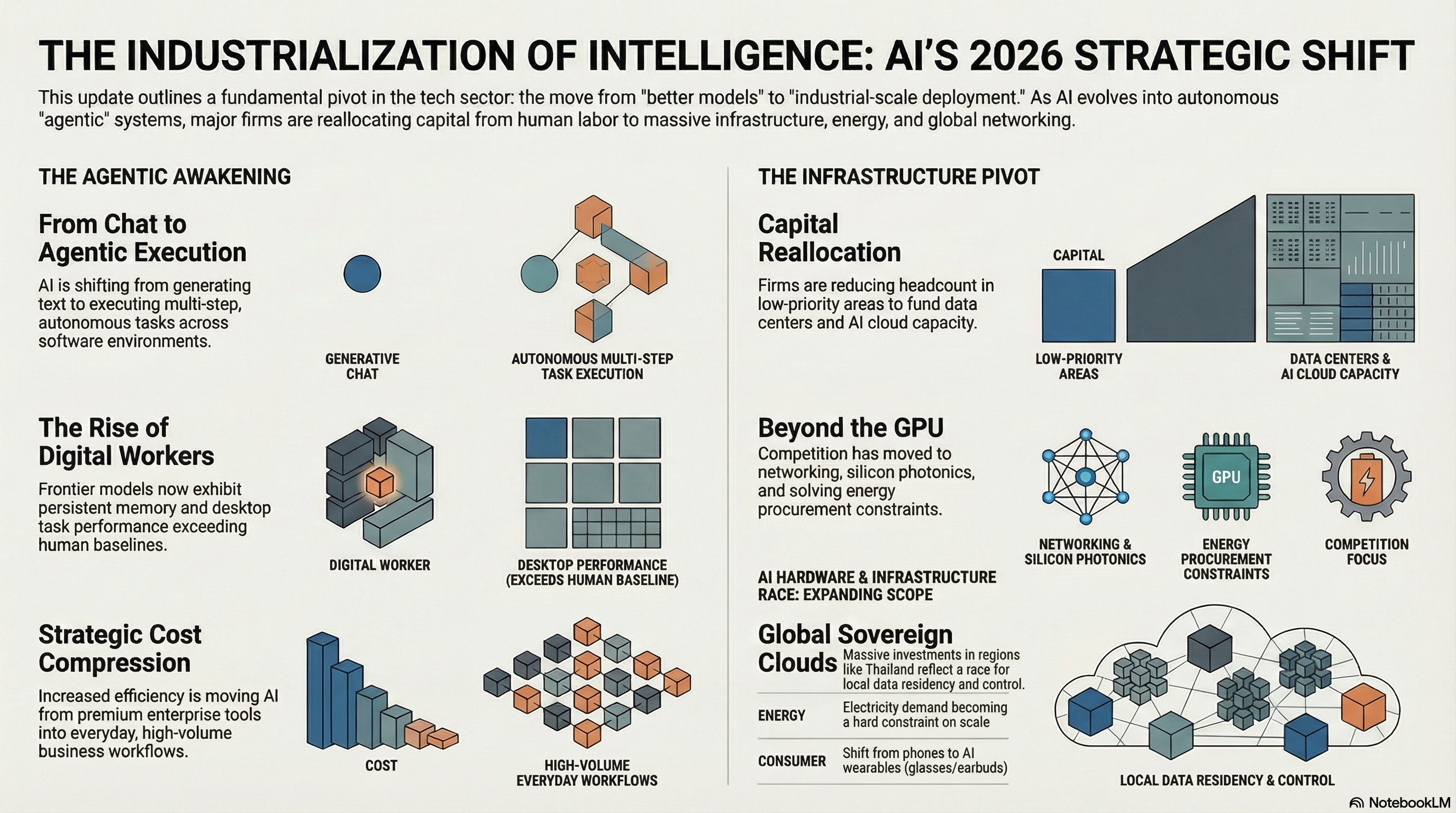
The Industrialization of Intelligence: AI’s 2026 Strategic Shift
This week’s biggest tech story is that AI is shifting from “better models” to “industrial-scale infrastructure and deployment,” while major companies are reorganizing capital, talent, and product strategies around autonomous systems and physical AI.
Listen to the Briefing Summary
The Infrastructure Race for Agentic AI - audio overview of this week’s key developments
AI and ML Breakthroughs
OpenAI’s GPT-5.4 and related frontier-model releases are a major signal that AI is moving from chat and generation toward autonomous task execution across software environments. Reported capabilities like persistent memory, multi-step planning, and cross-application integration suggest that models are increasingly designed to function as digital workers, not just assistants. The shift from “better answers” to “autonomous action” changes the competitive landscape: it’s no longer just about model quality, but about how deeply AI embeds in workflows.
Google is also pushing the frontier with Gemini upgrades and efficiency improvements, including broader workspace automation and lower-cost model deployment. That matters because cost compression is now one of the biggest drivers of adoption - as inference costs fall, previously uneconomical AI use cases become viable across mid-market and smaller enterprises.
A key broader trend is that AI is becoming more “persistent” and operational, with memory, multi-step planning, and workflow automation increasingly defining the state of the art. In practical terms, this means the next generation of enterprise software will be built around agents that don’t just respond to prompts but take ongoing responsibility for outcomes.
Big Tech Moves
Oracle’s reported layoffs alongside heavier AI and cloud investment are one of the clearest examples of capital reallocation in the tech sector right now. The strategic message is blunt: firms are cutting legacy teams and redirecting resources into AI infrastructure, data centers, and cloud capacity. That pattern is repeating across the industry and signals a deeper structural shift, not a cycle.
Microsoft’s reported multi-billion-dollar investment in Thailand shows how the AI race is becoming geographically global, not just centered in the U.S.. That expansion reflects both growth strategy and the growing pressure from governments demanding local AI infrastructure and data sovereignty.
Another major move is Nvidia’s reported $2 billion investment in Marvell, which highlights how AI competition is moving beyond GPUs into networking, silicon photonics, and data movement bottlenecks. It signals that the next performance frontier in AI is not just about compute power, but about moving data fast enough to feed increasingly hungry models.
Emerging Trends
The biggest emerging trend is the shift from generative AI to agentic AI, where systems don’t just respond but execute multi-step tasks autonomously. That will likely accelerate productivity in knowledge work, but also raise new questions about liability, oversight, and governance - areas where the regulatory frameworks are still catching up.
A second trend is AI infrastructure becoming an energy story as much as a compute story. Rising electricity demand, power-plant delays, and energy procurement challenges are becoming hard constraints on AI scale-up, which could shape where and how fast AI deployment grows.
A third trend is the widening hardware race around AI wearables and consumer devices, including smart glasses and AI-enabled earbuds. If these products gain traction, the next consumer battleground may move from phones and apps to lightweight always-on devices that blend vision, audio, and context-aware assistance.
Likely Impact
In the near term, these developments should drive faster enterprise adoption of AI, but also more restructuring inside tech firms as budgets shift from headcount to infrastructure. Expect more demand for governance and audit tools as AI moves from pilots to production-grade, always-on systems.
Over the medium term, the most important impact is economic concentration: capital, energy, and talent are clustering around a smaller set of frontier players and infrastructure providers. That can spur innovation, but also raises systemic risk - a dynamic regulators will increasingly need to address.
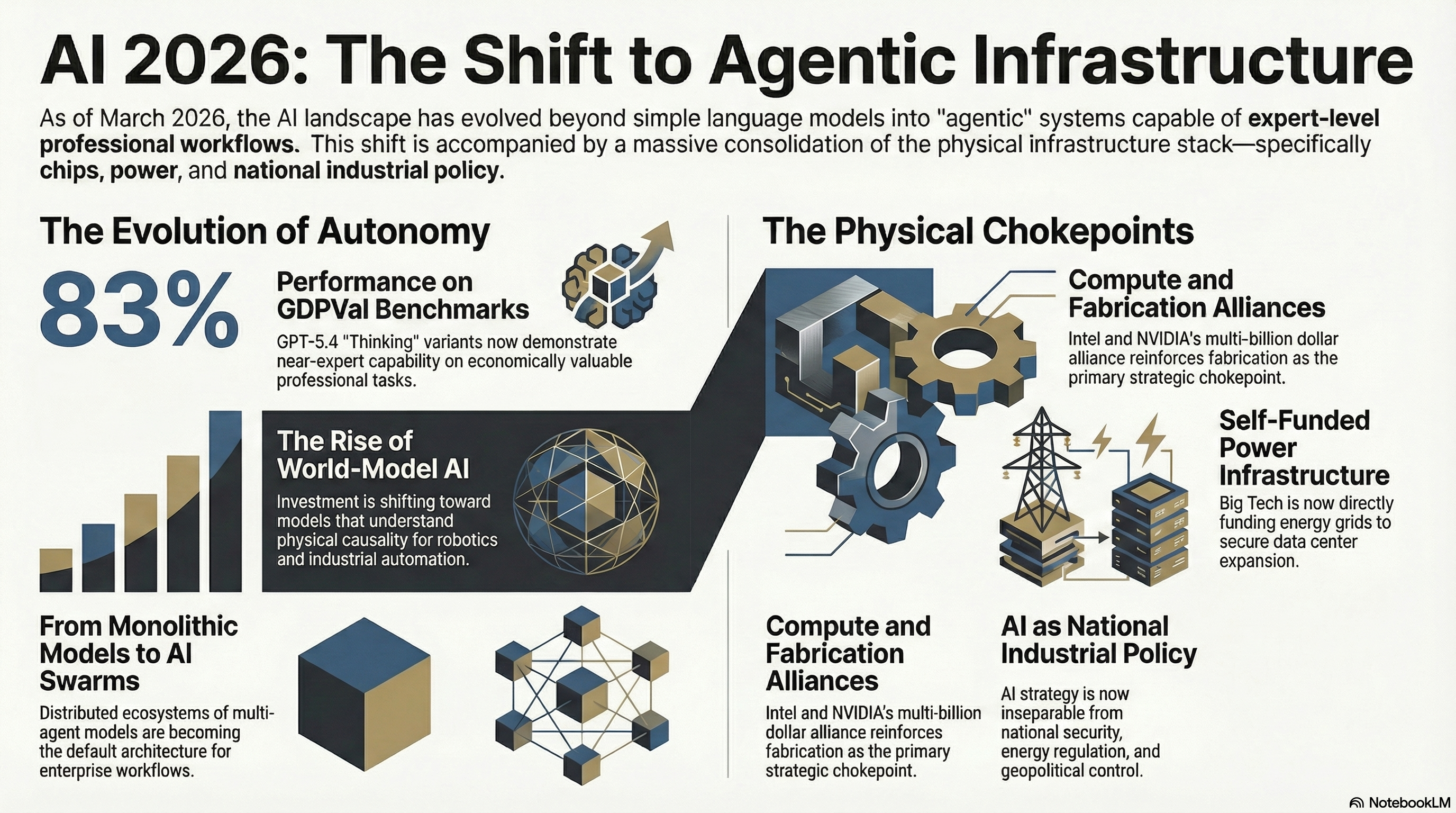
AI 2026: The Shift to Agentic Infrastructure
As of March 2026, the AI landscape has evolved beyond simple language models into “agentic” systems capable of expert-level professional workflows. This shift is accompanied by a massive consolidation of the physical infrastructure stack - specifically chips, power, and national industrial policy.
Listen to the Briefing Summary
AI Demands Gigawatts and Helium Beams - audio overview of this week’s key developments
AI and ML Breakthroughs
Frontier reasoning and agentic models continue to harden into production tools. OpenAI’s GPT-5.4 “Thinking” variants, with million-token context and native computer-use agents, are being framed as infrastructure for long-running, professional workflows rather than just chat, with 83%+ performance on GDPVal benchmarks (near-expert on economically valuable professional tasks). Google’s Gemini 2.5 Pro now leads major coding and reasoning benchmarks, and DeepSeek R2 is reportedly training at scale with strong early results, meaning the frontier is being pushed by at least three major independent efforts.
Embodied and world-model AI is attracting unprecedented capital. Yann LeCun’s new venture, AMI Labs, has reportedly raised over $1B in seed funding to pursue “world models” built on JEPA, emphasizing sensor-grounded, predictive AI suitable for robotics, AV, and industrial automation, a clear signal that investment is shifting from language to physical causality and real-world understanding.
AI agents and secure orchestration are becoming a competitive layer. Recent research and product updates around secure AI agents, prompt-injection defenses, and “computer environments” illustrate that the race is shifting from raw model quality to trustworthy, long-duration autonomy - how safely you let an agent operate across tasks, tools, and systems over hours or days.
Major Tech Company Strategic Moves
Chip and compute alliances are consolidating the AI infrastructure stack. Intel and NVIDIA have entered a multibillion-dollar AI chip alliance, while Broadcom is signaling that AI chip demand is already straining TSMC capacity; together these moves reinforce that access to advanced fabrication, networking silicon, and custom ASICs is becoming the primary strategic chokepoint in AI.
Big Tech is repositioning around AI platforms and cloud economics. Apple has set WWDC 2026 for June with explicit emphasis on AI-centric platform updates, essentially committing to close the perceived gap with rivals on device-integrated generative and agentic capabilities. At the same time, Microsoft has confirmed plans to invest $80B in AI data centres by late 2026, and Amazon’s growing push to self-fund energy infrastructure for data centres shows that competitive advantage is moving from software to physical plant.
Strategic funding and partnerships are elevating non-Big-Tech AI players. Mira Murati’s independent lab announced a multi-year gigawatt-scale partnership with NVIDIA for Vera Rubin processors, and startups like Lace have raised sizable rounds (e.g., $40M for helium atom-beam lithography) to push beyond EUV; these moves show the compute/hardware layer is becoming a venture-scale opportunity in its own right.
Emerging Tech Trends and Potential Impact
Agentic, multi-model ecosystems are becoming the default architecture. Between GPT-5.4’s native computer-use agents, Nemotron-based multi-agent setups, and cloud providers’ agent frameworks, the emerging pattern is “AI swarms” orchestrating tools, documents, and services rather than single monolithic models; this creates new governance, security, and accountability challenges that traditional compliance frameworks are not built for.
Edge, mobile, and open-source AI are reshaping deployment models. Gemini’s expansion into proactive task automation on upcoming flagship phones, combined with Alibaba’s continued push into open-source models, points toward a world where powerful assistants live on or near devices, with organizations facing new risks around model provenance, update management, and data governance.
Compute, power, and geopolitics are converging into a new “AI industrial policy.” Data-center operators and cloud providers are entering long-term arrangements with energy providers and governments, and regulators are increasingly focused on control over chips, fabs, and infrastructure; coupled with rising sovereign-AI mandates, this makes AI strategy inseparable from national security, energy regulation, and geopolitical control.
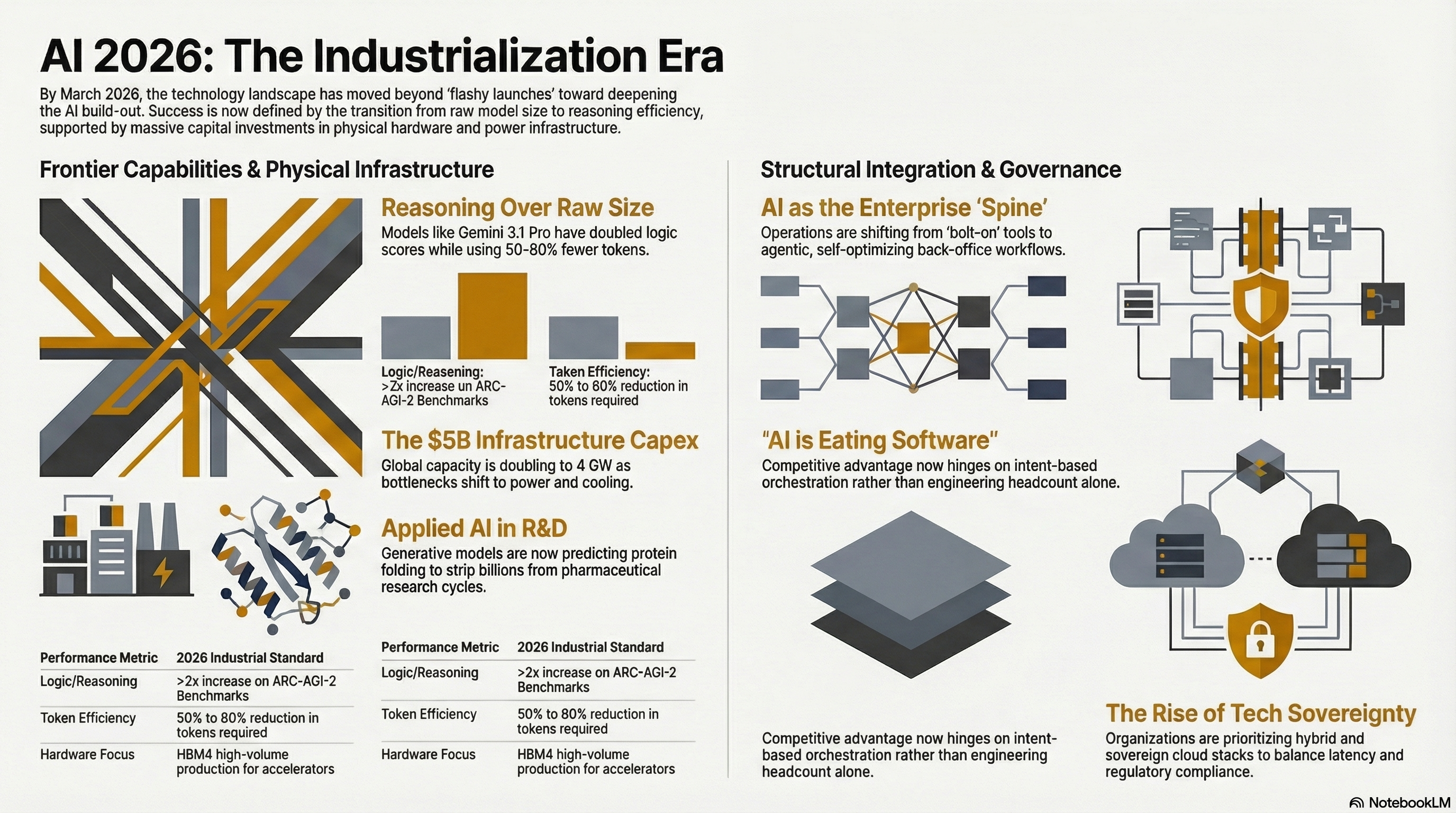
AI 2026: The Industrialization Era
This week’s technology landscape is defined less by flashy launches and more by deepening the AI build-out: smarter models, massive infrastructure bets, and “everyday AI” quietly permeating operations and devices. Together they signal a shift from experimentation to industrialization, with governance and compliance becoming critical.
Listen to the Briefing Summary
The Industrialization of Global AI Infrastructure - audio overview of this week’s key developments
AI and ML Breakthroughs
Frontier model quality is improving via reasoning and efficiency rather than just size: GPT-5 and Claude Opus 4.6 are reported to cut hallucinations dramatically versus prior flagships, especially when using extended “thinking” modes, while Gemini 3.1 Pro posts more than double its predecessor’s score on ARC-AGI-2 benchmarks. The competitive emphasis is shifting from raw parameter count to how reliably a model reasons, self-corrects, and handles ambiguity in professional contexts.
Architectural and training innovations (tiered KV caches, sparse decoding, synthetic data, improved data curation) are enabling models that match or beat earlier systems with 50-80% fewer tokens, pushing toward cheaper, more reliable inference at scale.
Applied AI in science continues to mature: an MIT generative model for protein-based drug design can predict folding and interactions for synthetic proteins, promising to strip billions from pharma R&D cycles and accelerate therapies for cancer, autoimmune conditions, and rare diseases.
For your AI-governance lens, the headline isn’t “AGI tomorrow” so much as: reasoning-optimized, lower-hallucination models are becoming viable co-pilots for high-stakes domains, which increases pressure on evaluation standards, safety disclosures, and domain-specific guardrails.
Major Tech Company Strategic Moves
Hyperscalers and chipmakers are doubling down on physical AI infrastructure: NTT Global Data Centers plans to double capacity to 4 GW to meet AI demand, underscoring that the bottleneck is now power, land, and cooling as much as algorithms. Micron, one of three major HBM suppliers, reported a surge in AI-related revenue, with HBM4 ramping into high-volume production for next-generation accelerators.
NVIDIA’s ecosystem is widening: partners like Penguin Solutions are launching “AI factory” offerings (e.g., OriginAI Factory), while Micron ramps HBM4 into high-volume production for NVIDIA accelerators, easing constraints on next-gen GPU deployment.
At the platform and device layer, giants are positioning around on-device and edge AI: Samsung’s Galaxy AI on S26 devices emphasizes privacy-preserving, on-device inference, while Huawei and others are rolling out AI-centric network and “Network in a Server” solutions to support low-latency, edge-heavy AI workloads.
For strategy and negotiation, the key pattern is that AI is now a capital-intensive infrastructure race (data centers, HBM, energy) layered on top of a standards race (APIs, model interfaces), which will drive new alliance structures, procurement models, and long-term offtake-style contracts.
Emerging Tech Trends and Impact
AI as backbone of enterprise architecture: 2026 is being framed as the year AI becomes the structural “spine” of enterprise systems rather than a bolt-on tool: intelligent operations, agentic workflows, and self-optimizing processes are moving from pilots into core back-office and customer-facing environments.
“AI is eating software”: Development is shifting from manually writing code to expressing intent while AI assembles and maintains systems; competitive advantage starts to hinge on orchestration, governance, and control of data and policies rather than engineering headcount alone.
Cloud 3.0 and tech sovereignty: To support AI at scale, organizations are moving toward hybrid, multi-cloud, and sovereign cloud stacks, balancing latency, data sensitivity, and regulatory requirements; tech sovereignty becomes a strategic concern as states and large enterprises seek control over critical AI infrastructure.
Everyday, invisible AI: Much of the new value is “quiet” - AI embedded into productivity tools, payments, and customer systems, reducing time and automating routine decisions without presenting as standalone products.
Strategic Implications
Governance and compliance: Lower-hallucination, higher-reasoning models plus AI-backbone architectures will require auditable pipelines, standardized model cards, and continuous monitoring - exactly the space where AI-governance platforms can differentiate by providing transparent, agent-level oversight.
Infrastructure-to-applications linkage: As data-center and HBM capacity become strategic chokepoints, procurement and contracting around AI infrastructure will increasingly intersect with AI-risk allocation, SLAs for reliability, and regulatory compliance covenants.
Human-AI collaboration: The move toward intent-based development and intelligent ops creates demand for embodied, practice-based leadership and negotiation capabilities that can integrate AI agents into workflows while maintaining human judgment, accountability, and psychological safety.
Previous Briefings
January - February 2026 archive of weekly intelligence updates.
Why Intelligence Matters for AI Governance
The pace of AI advancement creates governance challenges that traditional compliance approaches cannot address. Understanding these trends isn't optional - it's essential for building accountability frameworks that remain relevant as AI capabilities evolve.
Growth in enterprise AI usage (2024-2025) - monitoring at scale is now mandatory
Combined valuation of planned 2026 AI IPOs - investor scrutiny demands governance
Inference cost reduction enabling AI everywhere - without proportional governance investment